
Astraware Acrostic
Astraware LimitedWord
4.452.00 Reviews
- Version
- 2.93.001
- Installs
- 10.00K
- Age Rating
- Everyone
Screenshots
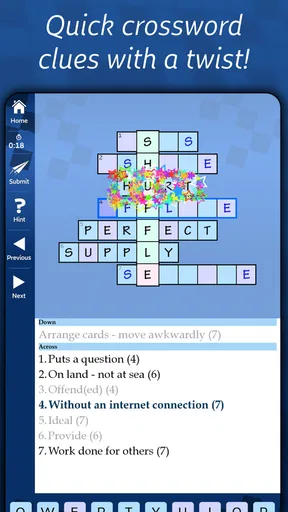
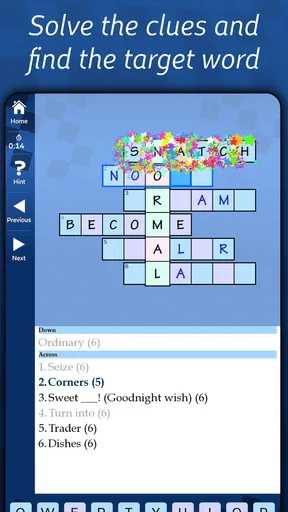
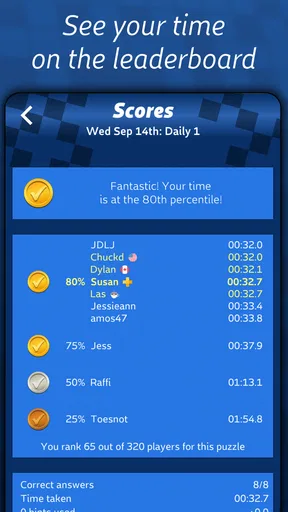
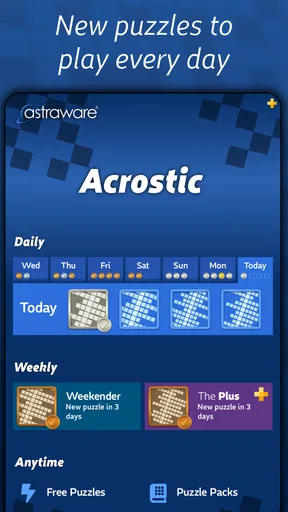
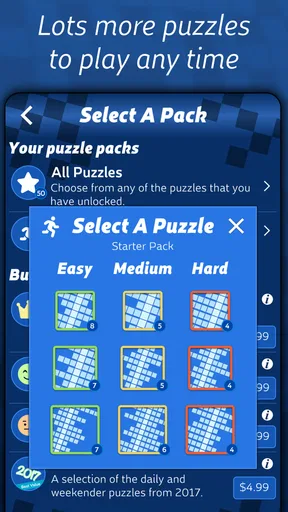
Our Review of Astraware Acrostic
 Analysis by Appyee
I found Astraware Acrostic easy to understand within a few minutes, but its real appeal appeared after I stopped treating it like a conventional crossword. It is a compact word game from Astraware Limited in which clues point toward a target word, creating a short, focused solving session rather than a large grid that demands a long uninterrupted sit-down. I would recommend it most to people who enjoy vocabulary puzzles and want something that can fit into small gaps during the day.
The game is free to start, carries an Everyone age rating, and belongs firmly in the word-game category. Its average rating is 4.4 from around 230 ratings, while its install count has passed 10 thousand. Those figures suggest a modest but interested audience rather than a huge mainstream phenomenon. After spending time with it, that feels fair: this is a specialized puzzle experience with a clear identity, not an all-purpose casual game.
How Astraware Acrostic works in everyday play
I find the game’s clue-to-target structure works best when I treat the clues as a connected set, not a row of unrelated definitions. I start with the most distinctive wording, keep uncertain answers flexible, and let a likely target reshape my guesses rather than forcing an early commitment. That approach makes a brief session useful even when I cannot finish the puzzle, and it helps explain where this format fits among everyday word games.
Readability and navigation come first
The central interaction is straightforward: I read a group of clues, work out the answers, and use them to identify the target word. That structure makes the game approachable because I am not required to learn a complicated control scheme before solving anything. The challenge comes from interpreting language, remembering possible answers, and noticing how the clues relate to one another.
That simplicity is especially useful when I want a puzzle that starts quickly. I do not have to manage a character, explore a map, or remember a chain of unrelated objectives. The screen is dedicated to the word problem in front of me. For players who find busy game interfaces distracting, this focused format is one of its strongest qualities.
I also like that the game encourages a different solving rhythm from a standard crossword. In a traditional crossword, a difficult clue can leave me staring at one empty square or waiting for crossing answers to help. Here, I can move between clues and use partial understanding of the target word to make progress. That makes the experience feel less like filling a rigid grid and more like assembling a set of connected ideas.
A useful habit is to read every clue once before committing to an answer. I often notice that the easiest clue gives me a letter pattern or a possible theme that changes how I approach the harder ones. Guessing too early can make me fixate on an attractive but incorrect answer, so I get better results by keeping two or three possibilities in mind until the surrounding clues narrow them down.
The navigation is best suited to someone comfortable reading text on a small screen. I found the basic flow easy to follow, but word games naturally place a lot of importance on letter shapes and clue wording. If I am tired, rushing, or playing in poor lighting, the mental effort feels higher than the simple interface might suggest. The game is visually calm, yet calm does not automatically mean effortless for every player.
Why the puzzle format helps different solving styles
One of the more inclusive aspects of the design is that it does not reward only one kind of intelligence. A player with a broad vocabulary may move quickly through definitions, while another player may succeed by spotting patterns, recalling phrases, or using the relationship between several clues. I enjoy that flexibility because a slow start does not always mean I am stuck; a later answer can unlock the whole puzzle.
It is also possible to play in a deliberately low-pressure way. I can solve one clue, pause, and return later without needing to preserve a complicated action sequence. That makes it more suitable than many fast casual games for players who prefer time to think or who do not enjoy penalties for slow reactions. The main demand is attention, not speed.
For younger players, the Everyone rating makes the game broadly suitable from a content perspective, but vocabulary difficulty will still vary by age and reading experience. I would not assume that a child who can operate a phone independently will automatically find every clue accessible. An adult, parent, or teacher may be able to turn the game into a shared activity by discussing possible meanings rather than simply supplying answers.
For older players, the format has a pleasant advantage: it can be enjoyed without learning modern game conventions. There is no need to understand a progression system or a large collection of menus before getting to the puzzle. Someone who already likes crosswords, anagrams, or quiz-style wordplay will recognize the basic pleasure immediately, while still having to adjust to the acrostic-style relationship between clues and the final answer.
Motor and sensory considerations
From a motor perspective, this is much less demanding than games that depend on rapid taps, swipes, or precise timing. My attention stays on selecting answers and reading clues rather than reacting to moving objects. That makes it a reasonable choice for a short session when fast touch controls would be tiring or frustrating.
Still, “low action” does not mean “no physical demands.” The player must tap accurately enough to choose an answer and move through the puzzle. Someone with limited dexterity may prefer using the device on a stable surface rather than holding it in one hand. I found that a relaxed posture matters because repeatedly adjusting a phone while thinking about a clue is more distracting than the puzzle itself.
Visual comfort is similarly dependent on the device and environment. Text-heavy games can be harder to use for people with reduced vision, glare sensitivity, or difficulty distinguishing small letter forms. I would test the game on the device I plan to use, increase the system text size if that improves general readability, and play with adequate lighting. Those steps may help, but they should not be confused with a guarantee that every element will scale or reflow perfectly.
Players who are sensitive to visual clutter may appreciate the restrained nature of a clue-based word puzzle. There is less movement and fewer competing objects than in an arcade game. On the other hand, anyone who needs strong contrast, large text, spoken content, or highly adjustable display controls should check the experience personally before relying on it as an accessible daily game. The puzzle’s quiet presentation is helpful, but it does not replace dedicated accessibility options.
Auditory access is not central to solving the puzzles because the essential information is written. That is a practical benefit for playing in places where sound is inappropriate or unavailable. I can approach the game as a silent activity, which is useful in a waiting room, on public transport, or beside someone who is sleeping. It also means the game’s core challenge is not locked behind audio cues.
Situational access during a normal day
The best everyday use case is a short break with an uncertain amount of time. I might open it while waiting for an appointment, solve the clues that come quickly, and stop when my name is called. The game does not require the same commitment as a long crossword book or a story-driven game. That makes it a good companion for fragmented schedules, provided I am comfortable reading and thinking on a phone.
It also works well as a shared, quiet puzzle. I can show a clue to a friend, compare possible answers, and use the conversation to approach the target word from another angle. This is more satisfying than simply asking someone to watch me play because the language itself becomes the social activity. A person who struggles with one clue may still contribute a useful association that another player misses.
For commuting, the lack of fast action is a clear advantage. I do not need to react instantly if the vehicle moves or my attention is interrupted. However, reading on a moving bus or train can still cause discomfort, and a crowded environment makes small text and precise tapping less comfortable. In that situation, I would choose a short puzzle rather than trying to force myself through a difficult one.
The game is also suitable for quiet evening use, especially when I want mental stimulation without the intensity of a competitive title. I would not describe it as a relaxation app, because a stubborn clue can be surprisingly demanding, but the pace is under my control. That distinction matters: it can be calming for someone who enjoys thinking, while being irritating for someone who wants instant, effortless entertainment.
Because the game is free, it is easy to try without making an immediate purchase decision. There are in-app purchases ranging from 99 cents to $7.99 per item, so I would pay attention to the purchase flow if I were handing the device to a child. The free entry point is useful for testing whether the clue style suits me, while the optional spending means the total experience may differ depending on what I choose to buy.
Where the experience still creates barriers
The biggest barrier is language dependence. This is not a puzzle that can be enjoyed fully through visual pattern recognition alone; understanding the clues and the target word is the point. Players learning English, dealing with dyslexia, experiencing word-finding difficulties, or simply lacking familiarity with a particular vocabulary may find the challenge much steeper than a store summary suggests.
That difficulty is not necessarily a flaw, but it affects who will feel comfortable. I would skip this game if I wanted a puzzle based mainly on numbers, pictures, or spatial movement. I would also look elsewhere if I needed a game with extensive customization for text size, contrast, input methods, or audio guidance. A conventional crossword app may offer a larger grid and more familiar clue-crossing support, while an anagram game may make each task more visually direct.
The acrostic structure can also produce uneven difficulty. A clue that seems obvious may still fail to help if I misunderstand the target word’s relationship to the other answers. Conversely, one strong insight can make several remaining clues fall into place quickly. I enjoy that swing, but players who prefer a steady, predictable difficulty curve may find it inconsistent.
Another trade-off is the lack of physical reference material. With a paper crossword, I can write tentative answers, circle possibilities, and spread the puzzle across a larger surface. On a phone, I am working within the limits of the screen and touch input. That is convenient for carrying the game everywhere, but less comfortable for anyone who likes to annotate, compare several alternatives, or use a dictionary beside the puzzle.
I would also avoid presenting it as an educational tool without qualification. It can encourage vocabulary practice, careful reading, and flexible thinking, but the experience is still a game first. It does not replace structured language instruction, and a player who needs explicit definitions, pronunciation support, or a guided learning path may be better served by a dedicated language app.
How it compares with familiar word-game alternatives
Compared with a standard crossword, Astraware Acrostic feels more compact and more interconnected. A crossword gives me a broad grid, crossing letters, and the satisfaction of filling a physical-looking structure. This game concentrates the challenge around the clues and their shared destination. I prefer it when I want a focused session; I prefer a full crossword when I want a longer project with more room to reason through crossings.
Compared with an anagram game, it asks for more interpretation and less rearrangement. An anagram title may give me a fixed group of letters and expect rapid word formation. Here, I spend more time deciding what a clue means and how several answers point toward one target. That makes it more rewarding for readers who enjoy definitions and associations, but less appealing to someone who wants a quick visual word scramble.
Compared with a word-search game, the experience is much less about scanning a field for familiar letter sequences. I am not simply locating words; I am building an answer from meaning. Players who experience visual fatigue from searching dense letter grids may prefer this cleaner conceptual task, while players who find definitions tiring may have the opposite reaction.
Its free starting point also makes it easier to sample than a paid puzzle book, though the in-app purchase range means I would still decide carefully how much I want to spend. The important question is not whether it replaces every other word game. It does not. Its value comes from offering a distinctive middle ground between a crossword’s clue solving and a short mobile puzzle’s convenience.
Practical ways to get more from each puzzle
I get better results by separating certainty from possibility. When a clue produces an answer immediately, I treat it as an anchor. For uncertain clues, I note the likely meaning mentally and wait for the target word to provide direction. This prevents one attractive guess from controlling the rest of the puzzle.
A second useful approach is to look for the clue with the most specific wording rather than the easiest-looking clue. A broad clue can have many plausible answers, while a narrow clue may reveal the shape of the target word. Solving in that order reduces wasted taps and gives the rest of the puzzle more structure.
I also recommend changing the physical setup before assuming the game is difficult to read. A stable position, reduced glare, and a comfortable viewing distance make a noticeable difference in a text-heavy puzzle. If I am playing late at night or in a moving vehicle, I accept that my solving speed may drop and avoid judging the game based on that session alone.
For a shared session, I would ask another player for associations rather than asking them to solve the clue outright. “What kind of word does this suggest?” keeps both people involved and can help a player who has trouble retrieving a word quickly. That makes the game more cooperative without changing its basic rules.
My inclusive verdict
Astraware Acrostic is a thoughtful choice for players who want a quiet, language-led game that can be picked up for a short period. I like its focused presentation, its low reliance on rapid motor actions, and the way one clue can illuminate several others. It is particularly suitable for crossword fans who want something more compact, people who enjoy solving through meanings and associations, and anyone looking for a silent puzzle during spare moments.
Its limitations are equally clear. The experience depends heavily on reading and vocabulary, and I would not choose it for someone who needs extensive display customization, spoken guidance, or a nonverbal puzzle format. Small-screen reading, touch selection, and uneven clue difficulty can also create friction. Those are important considerations for players with visual, motor, language, or concentration needs.
The game runs on devices using at least OS 9, and the current version is 2.93.001. Astraware Limited has kept the concept recognizable and focused rather than turning it into a crowded collection of unrelated activities. For me, that focus is the reason to try it: the best part is the satisfying moment when several separate clues suddenly point to one answer.
I would start with the free version, play in a comfortable environment, and decide from actual readability and clue difficulty rather than from the category label alone. If the format clicks, it offers a nicely portable word challenge. If I need broader accessibility controls, a larger workspace, or a more visual puzzle, I would choose another option instead. Overall, I see it as a worthwhile, specialized word game—simple to begin, more demanding to master, and most enjoyable when I have enough time to think without being hurried.
Verdict
Strengths of Astraware Acrostic
- Large puzzle library offers plenty of content for regular players.
- Clear letter-grid design makes clues and answers easy to follow.
- Helpful hints can assist when a puzzle becomes particularly difficult.
- Works well for short sessions or longer, relaxed gameplay.
- Suitable for vocabulary fans who enjoy word puzzles without time pressure.
Limitations of Astraware Acrostic
- Some puzzles may feel repetitive after extended play sessions.
- The difficulty curve can vary noticeably between individual puzzles.
- Players seeking fast-paced action may find the gameplay too slow.
- Hints and extra puzzle content may depend on in-app purchases.
- A larger screen is more comfortable for reading lengthy clue lists.
Other Releases by Astraware Limited
View All
Astraware Wordsearch
Word4.5
Similar Picks in This Category
View All
Word Search - Word Puzzle Game
Bluetile4.8

Word Search Quest - Puzzles
Blackout Lab4.8

CodyCross: Crossword Puzzles
Fanatee, Inc.4.7

Words of Wonders: Crossword
Fugo Games4.9

Wordscapes: Word puzzle game
PeopleFun4.7

Word Search Explorer
PlaySimple Games4.9
Frequently Asked Questions
What is Astraware Acrostic and how does the game work?
Astraware Acrostic is a word puzzle game based on the classic acrostic format. You solve a series of clues and use the answers to complete a quotation, phrase, or themed passage. As the puzzle fills in, the highlighted letters reveal the final solution. The game combines vocabulary, deduction, and quote recognition, making it suitable for players who enjoy thoughtful, slower-paced puzzles rather than fast arcade gameplay.
Is Astraware Acrostic suitable for beginners?
Yes, Astraware Acrostic is generally approachable for beginners, although some puzzles can become quite challenging. The clue-based format is easy to understand, and the game provides a comfortable way to work through answers gradually instead of requiring you to solve everything at once. Players who are unfamiliar with acrostics may need a little time to understand the letter patterns, but the learning curve is reasonable and rewarding.
Does Astraware Acrostic require an internet connection?
The core puzzle experience is designed to be playable without a constant internet connection, which makes Astraware Acrostic convenient for travel, commuting, or relaxing away from Wi-Fi. However, certain functions may depend on connectivity, such as downloading additional puzzle content, checking for updates, or accessing store-related features. It is a good idea to open the game online occasionally so its content and purchases can synchronize correctly.
Are there hints or assistance options when a puzzle is too difficult?
Astraware Acrostic includes helpful options intended to prevent players from becoming completely stuck. Depending on the puzzle and version, assistance may allow you to reveal letters or receive other forms of guidance. These tools are useful when a clue uses an unfamiliar word or when the quotation is difficult to identify. Using hints can reduce frustration, although players who prefer a pure challenge can choose to solve puzzles without assistance.
Is Astraware Acrostic free to download, and are there in-app purchases?
Astraware Acrostic may be offered as a paid download or through a version with optional purchases, depending on the platform, region, and current store listing. Before installing, check the Google Play or App Store page for the latest pricing and purchase information. Additional puzzle packs or other content may not be included in the initial download, so reviewing the listing is recommended if you want the complete collection of available puzzles.
Play our best games!


